
"The most expensive moment in a project's lifecycle is not when we make technical mistakes. It's the second when one leader lets go of the reins and the other has not yet grasped them."
Contemporary project management standards, led by the PMBOK® Guide and PRINCE2®, have equipped organizations with precise tools for controlling processes from initiation through closure. However, there is one area that academic textbooks and commercial methodologies still treat as a stepchild: the turnover of Project Manager during ongoing work (mid-project leadership transition).
While the business market often reduces this moment to a purely administrative “handover” and checklist transfer, my experience—as well as the scientific literature in the field of Project Management—has been sounding the alarm for decades that a leadership change is a critical turning point for the trajectory of the entire endeavor.
As a practitioner with 18 years of experience who has taken over dozens of projects in my career, I have repeatedly observed these mechanisms in the living organism of business. In this article, however, I refrain from describing pure operational practice. I invite you to dive deeply into the global scientific literature to see how academic research defines, maps, and attempts to solve the problem of project continuity (Project Continuity).
What Is Succession in Project Management?
In the classic business sense, Project Manager succession (PM Succession / Leadership Transition) is the process of transferring responsibility, authority, and decision-making roles between the outgoing and incoming Project Manager during the project’s execution. From a continuity management perspective, however, succession is not a one-time event or an administrative task.
In business reality, succession is nothing other than systematic protection of the project against chaos. It is about ensuring that the outgoing and incoming managers can transfer not only official files side by side, but above all real control over people, risk, and client emotions, without losing a single day of delivery.
Succession in a project is primarily a responsible relay of leadership. It is the moment when, instead of throwing the new manager into the deep end with the phrase “figure it out,” the organization creates conditions for a smooth transfer of control. The goal is to maintain operational stability and client trust, which takes months to build but can be lost in a single day.
1. The Critical Time Factor: When Does Turnover Hurt the Most? (Analysis by Parker & Skitmore and Altamimi)
One of the most important questions facing researchers of the turnover phenomenon (PM Turnover) is the issue of situating this change on the project timeline. The impact of a manager’s departure is not constant—it depends directly on the phase of the project lifecycle in which the changing of the guard occurs.
The foundation for these analyses was laid by the classic and most frequently cited study by Parker and Skitmore (2005). These authors empirically demonstrated that PM turnover most often occurs during the execution phase. This is logical from a business dynamics perspective—this is when the project encounters the greatest resistance, generates the most stress, and plans collide with reality. Parker and Skitmore proved that suddenly pulling a leader from a project in full swing during this phase drastically impacts team morale and directly worsens final performance indicators (project performance). The team loses direction, and the project freezes its momentum for weeks.
The latest groundbreaking work by Altamimi (2024) goes a step further and introduces a deep phase-based analysis that sheds new light on this phenomenon. Altamimi proves that both early turnover (during the planning phase) and late turnover destructively interrupt knowledge continuity (knowledge continuity).
The most important conclusion from Altamimi’s (2024) research, however, is the identification of an anomaly related to the project closeout phase. Theoretically, it might seem that changing the PM at the very end, when “everything has already been delivered,” is safe. The researcher proves it is exactly the opposite. A leadership change during the closeout phase drastically reduces client satisfaction and dramatically complicates formal acceptance and project settlement. Why? Because the new PM did not participate in the hundreds of micro-compromise agreements that took place during execution, rendering them defenseless when facing the client’s audit team.
2. The Learning Paradox and Organizational Absorptive Capacity (Bakker et al.)
The traditional approach to project handovers is based on the assumption: “if the outgoing PM describes the statuses well, the new one will step into their shoes without problems.” Science ruthlessly debunks this myth by introducing the concept of organizational absorptive capacity.
Key in this context is the study by Bakker and colleagues (2011), who defined the so-called project learning paradox. These researchers proved that the success of knowledge transfer during succession depends less on the efforts and goodwill of the outgoing manager, and critically on the organization’s ability to receive, understand, and integrate that knowledge.
In practice, this means that even if the outgoing PM prepares perfect, multi-page documentation, the process will still fail if the organization (including the new PM and PMO structures) does not possess systematic processes for capturing and absorbing knowledge. Bakker et al. (2011) show that knowledge in projects is temporary and dispersed, and without top-down defined absorptive mechanisms, it simply evaporates the moment the person physically leaves.
3. Dematerialization of Tacit Knowledge (Nonaka & Takeuchi and McKenna & Walker)
Why is project documentation insufficient to preserve continuity? The answer to this question lies in the structure of knowledge itself.
To understand this mechanism, project management literature draws extensively from the epistemological theory of knowledge creation developed by Nonaka and Takeuchi (1995). These researchers made a fundamental division into:
Explicit knowledge: data, schedules, budgets, status reports—that is, what can be written in files.
Tacit knowledge: intuition, decision context, relationship history, unwritten rules for working with difficult stakeholders, the emotional underpinnings of team conflicts.
Nonaka and Takeuchi (1995) argue that it is precisely tacit knowledge that constitutes the real advantage and operational strength of a leader. Translating this to the project domain, McKenna and Walker (2008) conducted detailed case studies analyzing knowledge transfer in dynamic project environments. They identified specific clusters of information that are most often irretrievably lost during personnel changes. These are almost exclusively elements of tacit knowledge—so-called silent documentation and the “oral history” of the project. McKenna and Walker (2008) prove that traditional handover procedures are structurally blind to tacit knowledge, forcing the new PM to rediscover America all over again (at great cost).
4. Paradigm Shift: The Role of Governance Structures (Pinto et al. and Tshuma et al.)
Since the literature diagnoses the problem so precisely, where do scientists look for solutions? The latest research trends clearly shift the burden of responsibility from the individual (the new PM) to the organization’s supervisory structures (governance).
In recent years, Jeffrey Pinto, Kate Davis, and Rodney Turner (2024)—absolute legends of global Project Management research—published work on project governance in crisis situations, with particular emphasis on the decision to replace the Project Manager (Project Manager Replacement). These researchers emphasize that taking over a project mid-flight is an entirely different management discipline than initiating it from scratch. It requires specific support from the organization in the first weeks after takingover responsibilities. Pinto et al. (2024) indicate that without a dedicated takeover plan supervised by senior management, the new PM is burned out at the start by operational pressure.
Who should be the operator of this process? The answer is provided by the latest research by Tshuma, Steyn, and Van Waveren (2024). These researchers analyzed the role of the Project Management Office (PMO) in the succession process. Their findings show that a mature PMO must stop being merely a passive repository of documents and become an active moderator and regulator of knowledge transfer. Tshuma et al. (2024) identify three key pillars of successful project takeover that the organization must manage:
A culture of openness and knowledge sharing (knowledge-sharing culture),
Structural trust among process participants,
Formalization and standardization of the takeover process itself.
What do global PMI standards say about PM rotation and succession?
Analysis of **Project Management Institute (PMI)** publications clearly indicates that rotation in the Project Manager position (PM Turnover) is not merely a personnel change, but above all a critical risk point for the entire organization.
PMI experts in their research and publications highlight five key findings that directly support the need for systematic succession management:
Project Takeover is a fresh start, not just passing the baton (*”Midstream Maneuver”*)
PMI recommends that a new PM treat onboarding to an ongoing project partly as launching a new initiative. A rapid audit of the project status, direct conversations with key stakeholders, and verification of documentation assumptions are essential to take real control, not just nominal responsibility. “Read more about why taking over an ongoing project generates the greatest risk in the article: why-project-takeover-is-harder-than-handover-and-why-takeover-generates-the-greatest-project-risk
Lack of structured knowledge transfer generates measurable losses (“Blueprints of knowledge”*)
PMI data shows that organizations lacking a formal *knowledge transfer* process pay for it with extended task completion times, increased error rates, and declining team morale. Typically, knowledge avoids formal documentation and disappears with the departing PM.
Handover must be a planned process (*”It’s so hard to say goodbye”*)
Transferring responsibilities cannot be a spontaneous event two days before an employee’s departure. It requires early involvement of the successor in meetings, systematized risk management, and securing continuity of relationships with key stakeholders.
Building credibility from day one (*”So you’re the new project manager”*)
From the perspective of a new leader, the most important thing in the first days after taking over an ongoing project is quickly understanding its actual status and regaining trust and credibility (*credibility*) in the eyes of the team and sponsor.
Constructing a formal transition plan (“Give and go: Organizational talent transitions”*)
Effective succession requires clear timeframes, formal review of tasks and open issues, periodic evaluations during the transition, and official confirmation of transfer completion.
Over years of taking over and handing off projects, I developed what I call the Takeover & Handover Protocol, which is part of my Project Takeover & Handover toolkit.
Response to industry challenges: Project Continuity System™
The conclusions from PMI publications clearly show that relying solely on individual PM competencies or ad-hoc Excel files is an enormous risk for the company.
That’s precisely why within the **Project Continuity System™** we combine PMI recommendations and global research into one integrated mechanism—so that rotation in the leadership position does not destabilize the project portfolio, and succession becomes a predictable, controlled business process.
Conclusions: Where science and industry standards meet Project Continuity System™ (PCS™)
Analysis of the above sources leads to one disturbing conclusion: the traditional approach to project management (based on documentation and operational checklists) is helpless in the face of leadership turnover.
Both academic literature and industry standards represented by Project Management Institute (PMI) precisely identify gaps in existing practices:
Parker (2005) and Altamimi (2024) show how the moment of change devastates the project and client relationships.
Bakker (2011) proves that organizations cannot absorb knowledge.
Nonaka (1995) and McKenna (2008) expose the fact that we lose the most valuable, tacit knowledge about the project.
Pinto (2024) and Tshuma (2024) call on PMO structures to create formal defensive mechanisms.
PMI publications (Midstream Maneuver, Blueprints of Knowledge, It’s So Hard to Say Goodbye) unequivocally confirm that changing a PM during a project requires an approach analogous to launching a new initiative—with focus on rapid status audit, planned succession, building credibility, and a formal transition plan, without which the organization loses efficiency and morale.
It is precisely these scientific findings, PMI guidelines, and identified market gaps—alongside my 18 years of experience and hundreds of conversations with mentees—that formed the foundation for creating my proprietary approach, which I define as Project Continuity Management.
My Project Continuity System™ (PCS™) was created not as an alternative to PMBOK® or IPMA, but as the missing link that addresses all the above risks. By implementing specific process steps and shifting the perspective from retrospective Handover (settling the past) to prospective Takeover (securing stability for the future), PCS™ equips PMOs with tools to build organizational resilience to rotation.
Science and global standards have proven how serious this disease is. My role as a practitioner and mentor was to create an effective cure for it.
Bibliography (APA 7 Standard):
Altamimi, M. Q. (2024). Project Management Turnover: Causes, Timing, and Impacts on Performance. Business & IT, 14(2), 23–32. https://doi.org/10.14311/bit.2024.02.03
Bakker, R. M., Cambré, B., Korlaar, L., & Raab, J. (2011). Managing the Project Learning Paradox: A Set-Theoretic Approach Toward Knowledge Transfer. Project Management Journal, 42(6), 8–22. https://doi.org/10.1002/pmj.20263
Dubber, R. J., & Pretorius, J. H. C. (2016). Investigating the Effects of Replacing the Project Manager During Project Execution. Proceedings of the 2016 IEEE International Conference on Industrial Engineering and Engineering Management (IEEM), 234-239.
McKenna, S. A., & Walker, D. H. (2008). Knowledge Management and Knowledge Transfer in a Dynamic Project Environment. International Journal of Managing Projects in Business, 1(2), 216–231. https://doi.org/10.1108/17538370810846277
Nonaka, I., & Takeuchi, H. (1995). The Knowledge-Creating Company: How Japanese Companies Create the Dynamics of Innovation. Oxford University Press.
Parker, S. K., & Skitmore, M. (2005). Project management turnover: causes and effects on project performance. International Journal of Project Management, 23(3), 205–214. https://doi.org/10.1016/j.ijproman.2004.10.004
Pinto, J. K., Davis, K., & Turner, R. (2024). Governance in a Crisis and the Decision to Replace the Project Manager. International Journal of Project Management, 42(4), 102-115.
Tshuma, B., Steyn, H., & Van Waveren, C. C. (2024). The Role of the PMO in Facilitating Knowledge Transfer during Project Manager Transitions. South African Journal of Industrial Engineering, 35(1), 45-58.
Project Management Institute (PMI) – Midstream Maneuver: Careful Research Can Smooth the Transition When Inheriting a Project.
https://www.pmi.org/learning/library/midstream-maneuver-smooth-transition-inheriting-project-2182
Project Management Institute (PMI) – It’s so hard to say goodbye.
https://www.pmi.org/learning/library/say-goodbye-knowledge-transfer-5980
Project Management Institute (PMI) – Blueprints of knowledge: Transferring knowledge in project management.
https://www.pmi.org/learning/library/blueprints-knowledge-transferring-project-management-6889
Project Management Institute (PMI) – So you’re the new project manager: tips for a good start.
https://www.pmi.org/learning/library/new-project-manager-tips-good-start-6687
Project Management Institute (PMI) – Give and go: Organizational talent transitions.
https://www.pmi.org/learning/library/organizational-talent-transitions-give-go-10234

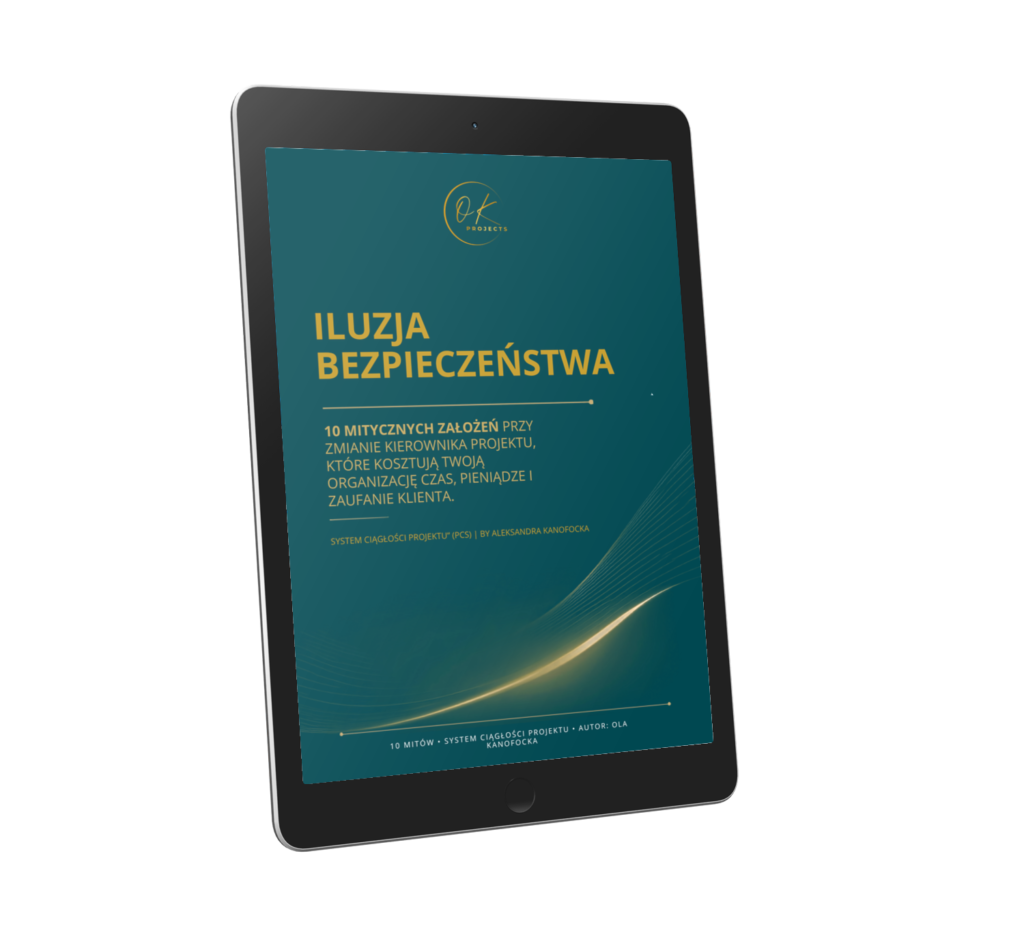
Dlaczego tradycyjne podejście do sukcesji zawodzi?
Tradycyjne metody zarządzania projektami próbują rozwiązywać problem rotacji za pomocą statycznych checklist i folderów z dokumentacją. Dają one jedynie iluzję bezpieczeństwa — poczucie, że skoro pliki zostały przekazane, to kontrola nad projektem została zachowana.
Zanim wdrożysz ustrukturyzowany standard Project Continuity System™, musisz zidentyfikować błędne przekonania, które najczęściej prowadzą do cichego paraliżu decyzyjnego.
W e-booku Iluzja bezpieczeństwa: 10 mitycznych założeń przy zmianie Project Managera opisuję 10 najczęstszych pułapek myśleniowych kadry zarządzającej oraz ryzyka, które ze sobą niosą. Poznaj je, aby dowiedzieć się, dlaczego Twoja organizacja potrzebuje systemowego podejścia do ciągłości decyzyjnej.