Project Manager turnover is a fact. Chaos is a choice.
Project Continuity System™ PCS™ – The standard for project continuity during Project Manager transition developed by Aleksandra Kanofocka
A systematic approach to Project Takeover Handover that minimizes risk, protects knowledge, decisions, and business stability.
- the project formally “moves forward”
- documentation “sometimes” exists
- but the project loses direction, momentum, and decision-making coherence
- loss of project knowledge and context of previous decisions and agreements
- information chaos and lack of clear priorities undocumented risks and project dependencies
- team tensions and stakeholder and client uncertainty
- decline in project execution pace
- loss of project value
It’s a lack of system.

Most problems during Project Manager transition do not stem from lack of people’s competence, but from flawed organizational assumptions.
Common myths create more or less hidden risks that silently generate enormous business costs — delays, chaos, and loss of client trust.
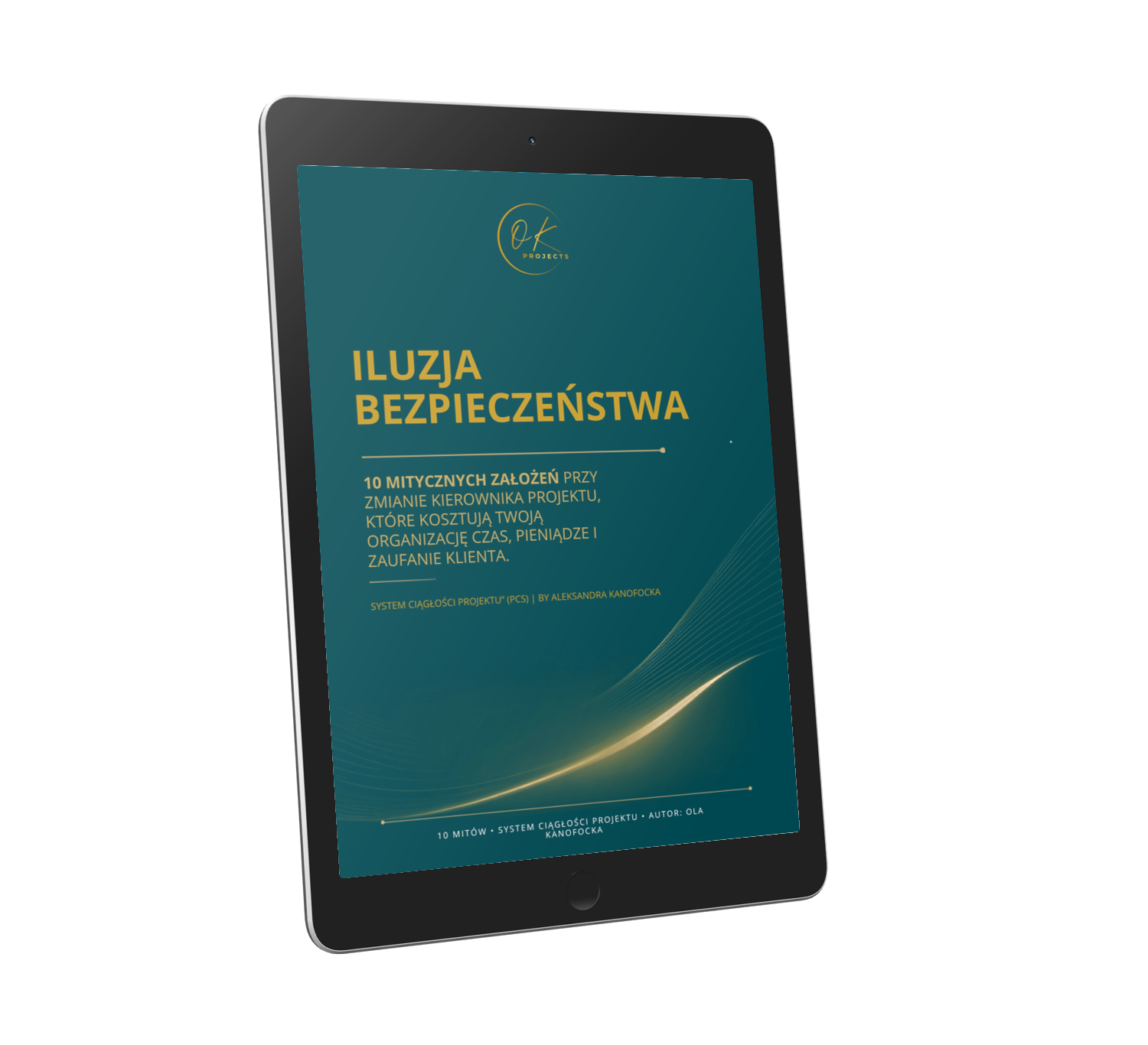
Download the free Executive Briefing “10 Mythical Assumptions” and see how, with the proprietary TOP 10 Golden Rules, you can move from the illusion of security to full project continuity with Project Continuity System™.
What is Project Continuity System™
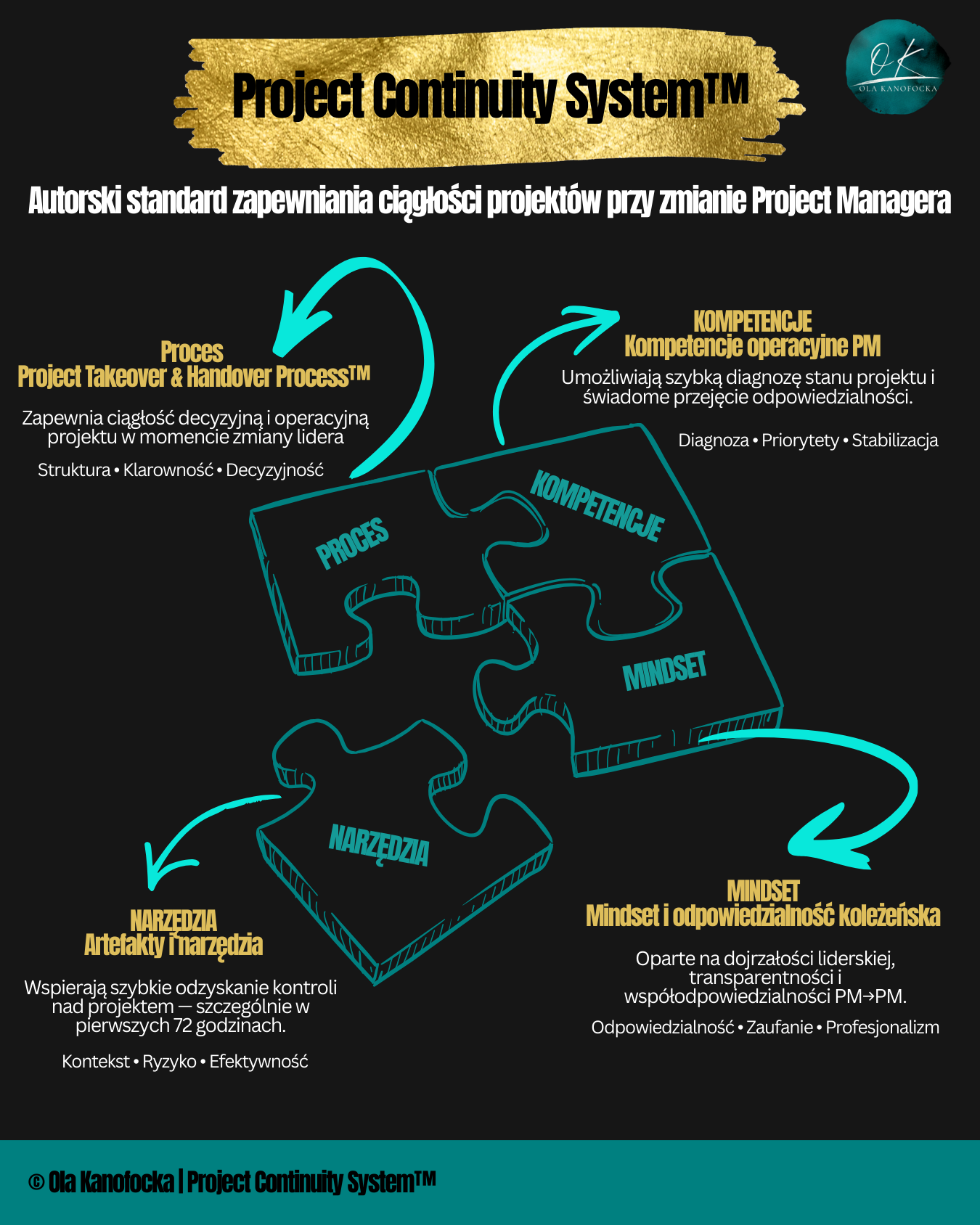
Project Continuity System™ is a proprietary standard for ensuring project continuity during Project Manager transition.
The system combines the Project Takeover Handover process with the project leader’s competencies, the right mindset, and a set of practical operational tools.
Thanks to this, Project Takeover ceases to be an improvisation — and becomes a structured management process.
PCS Is:
- a project resilience system
- an organizational standard
- practical support for PMs
It was developed based on over 18 years of experience in Project Takeover Handover carried out in the public and private sectors. It is the essence of my own hard-won lessons learned, built over 18 years across dozens of projects that I personally took over in vastly different industries and states – from stable implementations to critical rescue operations.
Based on solid foundations” “My PCS™ method combines 18 years of practice with an analysis of the latest global research on leadership succession.”
Read more about the substantive foundation and scientific research on this topic HERE.
PCS™ Diagnostic System
Within the PCS™ methodology, we use proprietary Gap Mapping visualization tools that allow for an instant biopsy of project status and competencies.
PCS Project Wheel™: A visual audit of 8 key project areas (e.g., finances, hidden risks, client relations, silent documentation). It allows a new PM to diagnose in 15 minutes the actual state of the project and its readiness for handover, and where the project loses stability.
PCS Competence Wheel™: A diagnostic tool for leaders, mapping the competencies necessary for safe succession (e.g., Himalayan PM Mindset, assertiveness in crisis, data analysis skills, or recognizing manipulation).
PCS Organizational Audit: A comprehensive audit for companies (PMO), assessing the entire organization’s resilience to staff turnover (project managers) and the security of knowledge transfer.

Process
A structured Project Takeover Handover model that eliminates improvisation during leader transition. It ensures a smooth transfer of responsibility without losing delivery momentum.
TOOLS Practical diagnostic and operational Toolkit.
A practical set of operational tools (e.g., GAP Mapping, 72h Checklist) that allows for immediate project stabilization and measurable risk minimization.
Mindset
Leadership maturity and PM-to-PM responsibility. The foundation is an approach based on transparency and mutual support among leaders. Himalayan PM Mindset is mental resilience and professional ethics that allow for maintaining decision-making calm and team stability even in the most demanding project phases.
COMPETENCIES
A set of skills necessary to take the helm in conditions of uncertainty and time pressure. Building the new leader's authority from day one.
GENESIS
GENESIS: Project Continuity System™ was created based on over 18 years of work in projects, programs, and portfolios.
It evolved in practice — in real situations of taking over and handing over projects, working with teams, and managing risk at the organizational level.
It is a response to:
- recurring problems during Project Manager turnover
- questions from mentees and workshop participants
- real gaps observed in organizations
The system evolved:
- from a checklist
- through a process
- to a coherent project continuity management system
Today, I also develop PCS based on international training standards.
The proprietary Project Takeover and Handover training within PCS has received accreditation from Brian Tracy International (BTI) — one of the most recognized global training organizations.
This means the program:
- was designed according to proven, global standards for business trainers
- is based on adult learning methodology (learning by doing)
- focuses on real application in the project environment
- combines project practice and strategic approach

Czy zmiana Project Managera w Twojej firmie opiera się na faktach, czy na iluzji?
Większość firm zakłada, że przekazanie projektu to prosta czynność administracyjna. Przekazujemy dostęp do dysku, wysyłamy link do Jiry, organizujemy jedno spotkanie i zakładamy, że nowy lider bez problemu przejmie stery. W rzeczywistości to właśnie powszechne, błędne przekonania dotyczące sukcesji stanowią największe ukryte ryzyko dla budżetu i harmonogramu. Pobierz bezpłatny e-book: Iluzja bezpieczeństwa: 10 mitycznych założeń przy zmianie Project Managera i sprawdź, które mitologiczne założenia zagrażają stabilności Twojego portfela projektów oraz jak przekształcić chaotyczną zmianę w bezpieczny, powtarzalny proces.
The most expensive moment of a project that no one talks about.
Project Manager transition is treated as a formality.
In practice, however, it is one of the most costly moments in the project lifecycle.
Cost 1 — delays in execution
The lack of a systematic Project Takeover process means that project stabilization typically takes 2–3 weeks, and sometimes even a month or two. This is a time when the project often operates more slowly and in reactive mode.
Cost 2 — double work
The new Project Manager must reconstruct the context of decisions, risks, and agreements that were not documented in the organization. The result: - meetings repeated - analyses performed again - team time used inefficiently, tasks and discussions are repeated
Cost 3 — loss of business value
Delays in project decisions translate directly into: • slower delivery of results • postponement of business benefits • greater risk of losing competitive advantage The scale of the cost depends on the turnover scenario — whether it is sudden or planned and at what stage of the project the transition occurs. However, the cost always exists and is often underestimated.
Cost 4 — reputational cost for the Project Manager
The new project leader is sometimes judged before they can build full project context. Time pressure, stakeholder expectations, and situational uncertainty increase stress and the risk of poor decisions.
Cost 5 — client cost and business relationship cost
Any disruption to project continuity can mean: • loss of client trust • risk of contractual escalation • additional operational costs for the organization
Cost 6 - Cost of indecision
Sometimes the greatest cost is actions and decisions not taken, and false savings...
Who is PCS for?
PCS was created at the intersection of these two worlds — the individual responsibility of the PM and the systemic responsibility of the organization.
For Project Managers and leaders
For those who:
- are taking over a project from someone else and want to quickly regain control
- are handing over a project and want to do it professionally, without leaving chaos behind
- feel responsible not only for the outcome, but for how the project is run
PCS gives you a structure for action in a situation that in most organizations is left to improvisation.
It’s a competence that genuinely sets PMs apart in the market.
For companies, PMOs, and organizational leaders
For organizations that:
- experience Project Manager turnover
- observe declining project quality during transitions
- want to reduce operational and business risk
PCS enables you to:
- streamline the PM transition process
- secure project knowledge
- increase delivery stability at the program and portfolio level
It’s a shift from dependence on people to systemic project continuity management.
HOW I HELP
For PMs and leaders
- Masterclass Project Takeover Handover
- Mentoring Takeover 72h
- Toolkit and tools (Project Takeover Rescue Kit)
For companies and organizations
- Project Continuity Audit (GAP Assessment)
- Training for PMs and PMOs
- PCS™ Implementation
- Support during real PM transitions
Why does this happen?
Because in many organizations, Project Manager transition is still not treated as part of the project management system,
but as the individual responsibility of the leader.
Handover/Takeover without a standard process often means improvisation and intuition.
Schedule an initial conversation and let’s calculate together how much you’re paying for the lack of a solution.