Project Continuity System™ (PCS) is a proprietary standard for ensuring project continuity during Project Manager transitions.
“The larger and more complex the project, program, or portfolio, the greater the risk that lack of systematic handover will expose decision gaps, dependencies, and organizational stability.”
Project Manager transition is one of the most underestimated risks in the project lifecycle.
For years I observed the same scenario – regardless of industry, project scale, or methodology used:
The PM leaves or changes roles,
the project is formally “handed over,”
documentation exists,
yet the project loses control, momentum, and decision-making coherence.
The team begins acting conservatively.
Stakeholders lose trust.
The new Project Manager makes decisions without full context for the first few weeks. Often they assume the role of “hero saving the project” and blame all gaps and problems on poor or missing handover and the previous Project Manager. Is this convenient? To some extent perhaps, but is it professional? Necessary? Absolutely not!
This is not one person’s problem.
This is a problem of lacking a proven system.
It was precisely from this observation that Project Continuity System™ (PCS) was born.
Genesis: from checklist to system
When I took over one of my first projects many years ago, no one told me where to actually start.
There was documentation.
There was a plan.
There were status reports.
However, there were no answers to the questions that in practice determine project success:
which decisions are truly critical,
where the project is most fragile,
what trade-offs have already been made – and with what consequences,
what is not visible in reports but is crucial for the client and team.
With each subsequent project takeover, I saw more clearly that formal artifacts do not reflect the true state of the project. They lack context, decision history, tensions, and risks that do not fit into tables and status reports.
The first tool I created, primarily for my own needs, was a simple checklist – a list of questions that allowed me to quickly understand what is really happening in the project. It helped me take over responsibility efficiently, without destabilizing the team and – most importantly – without harming the business and client relationships.
Over time, I began to notice that the same questions and steps repeated regardless of industry, scale, or project type. The first patterns emerged: sequence of actions, critical takeover moments, elements whose omission almost always led to problems.
This is how the proprietary Project Takeover & Handover Process was created.
This process was developed and validated in practice for many years – not only in real projects, but also in training and workshop settings. I conducted training sessions and expert sessions based on this process at IBM and Kyndryl, among others, and also shared it during PMI congresses and IPMA conferences.
It was there, in conversations with Project Managers, PMO leaders, and project managers, that the same questions kept recurring:
How to successfully take over a project? How to quickly regain context? How to protect the organization in case of PM turnover?
Participants asked for concrete tools, checklists, and structure that would allow them to apply this approach consistently in their organizations.
It became clear that the problem was not isolated, and the need was universal. At the same time, I saw increasingly clearly that the process alone was not enough. Project continuity does not depend solely on a list of steps, documents, or handover meetings. It equally depends on the Project Manager’s operational competencies, approach to responsibility, ability to quickly diagnose risks, and capacity to stabilize a project under pressure and uncertainty.
It was precisely the need to organize these elements and share them in a coherent, accessible form that led to the creation of Project Continuity System™ (PCS) – a systematic standard that combines process, competencies, mindset, and tools, addressing the real gap between project management methodologies and operational practice.
The system was built on over 18 years of experience and one recurring question I heard in projects, training sessions, and conferences:
How to ensure project continuity when the person responsible for leading it changes?
What is Project Continuity System™
Project Continuity System™ can be described on several complementary levels:
PCS is a project continuity standard
– it defines what must be secured during a Project Manager transition so the project does not lose business direction, decision-making knowledge, and operational stability.
PCS is a project resilience system
– it allows projects to “survive” a leadership transition without losing value, client relationships, and team trust.
PCS is a framework for organizational accountability
– it shifts the burden of continuity from an individual PM to the organization, PMO, and systematic approach to risk.
PCS is practical support for PMs
– it provides concrete tools, questions, and action priorities, instead of expecting that “an experienced PM will manage somehow.”
Project Continuity System™ – summary of the proprietary standard manifesto
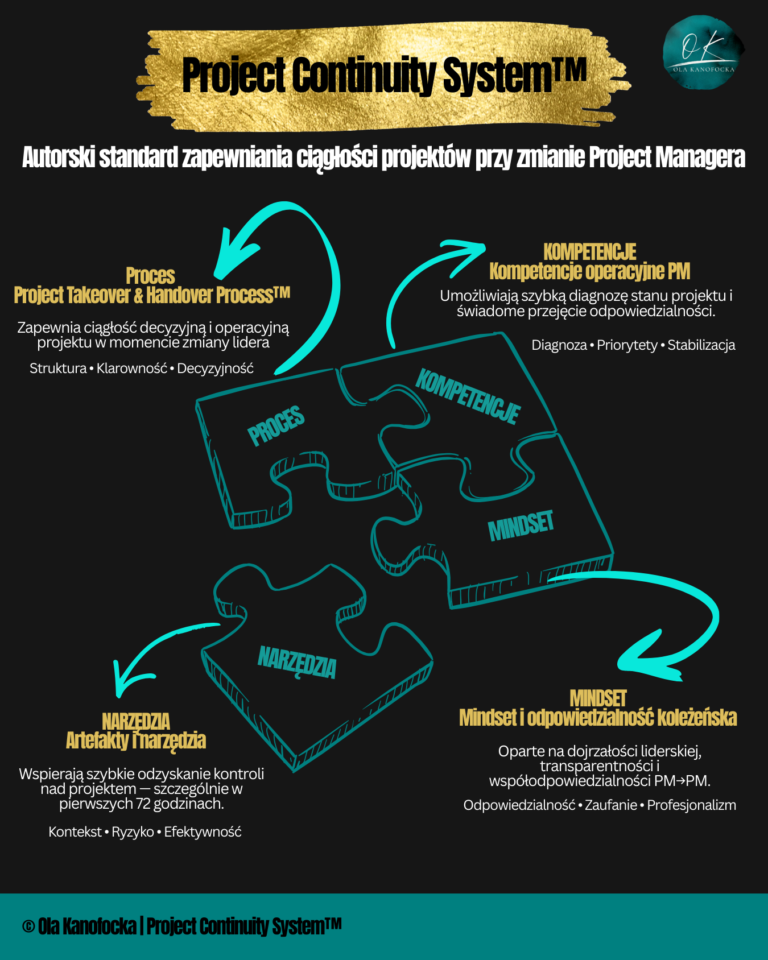
Project Continuity System™ is based on several fundamental principles:
Project Manager transition is an event of high operational and business risk, not a formality,
projects should not depend on a single person,
documentation without context does not ensure continuity,
true continuity requires combining process, competencies, mindset, and tools.
PCS encompasses four key pillars:
1. Process
Standardized Project Takeover & Handover Process™, which organizes Project Takeover and Handover in a way that ensures decision-making and operational continuity. A proprietary process that is scalable and applicable in various scenarios and situations involving project leadership transition.
2. Competencies
A set of practical PM competencies essential in Project Takeover situations, crisis, uncertainty, and time pressure.
3. Mindset and peer accountability
An approach based on PM→PM mutual accountability, transparency, and leadership maturity during responsibility transitions.
4. Artifacts and tools
Simple, effective diagnostic and operational tools (including Project Continuity Toolkit, GAP Challenge, 72h checklist, handover questions) that allow quick recovery of project control.

Strategic consulting for executives, portfolio managers, PMO, and project leaders
If your organization is facing sudden PM turnover or wants to protect projects and the project portfolio from domino effects, I can help: through strategic consulting for executives and portfolio managers or workshops for PMO and project leaders I will also gladly conduct a handover process audit and project risk assessment for you.
Why PM transition is a systemic risk
In many organizations, Project Manager transition is treated as an operational event.
Meanwhile, in practice it is an event of high systemic risk, because:
decision-making knowledge is dispersed and often undocumented,
dependencies between projects, programs, and portfolios are hidden,
key trade-offs exist only “in people’s heads.”
The greater the scale and complexity of the initiative, the greater the consequences of lack of continuity:
from a single project, through a program, to an entire portfolio.
Therefore, PCS does not focus solely on handover as an event,
but on decision-making and operational continuity over time.
Why Project Continuity System™ was created
PCS was created in response to a gap and lack of a defined standardized process in project management methodologies. It was created because:
organizations lack a systematic approach to PM turnover,
PMs are left on their own at one of the most difficult moments of the project,
classic standards treat the topic of responsibility takeover marginally,
lack of continuity generates real costs for projects and companies: delays, escalations, loss of trust.
every Project Manager faces this problem at some point in their career, and I want to show not only how to do it professionally but also how to prepare for it in advance.
Project Continuity System™ addresses this problem directly – without complication, without heavy processes, without “paperwork for paperwork’s sake.” Simple but effective and proven steps and tools.
What PCS is not
For clarity:
PCS does not replace methodologies.
PCS is not a checklist to tick off.
PCS is not a solution only for “projects in crisis.”
It is a project resilience system that works before a crisis appears. It is a proactive, preventive action, a response to the risk of losing project and business continuity.
Project Continuity System™ does not compete with Agile, PMI, or PRINCE2.
It operates above methodologies, regardless of industry, project scale, and delivery model.
Who Project Continuity System™ was created for
Project Continuity System™ was designed with two key audiences in mind. The first are individual Project Managers – both those who take over a project from someone else and must quickly regain decision-making control, and those who hand over a project and want to do so professionally, responsibly, and safely for the team and stakeholders.
The second group are organizational leaders: PMO Managers, Program and Portfolio Managers, business owners, and directors who want to implement standards, train teams, and systematically protect the organization from the effects of Project Manager turnover, ensuring project, program, and business continuity – regardless of personnel changes.
Foundation for further action
This article is a starting point.
In subsequent publications I will develop topics including:
why handover is a critical process, not an administrative one,
how risk grows with the scale of projects, programs, and portfolios,
what are the real costs of lacking systematic Project Takeover,
how to practically implement Project Continuity System™ elements in organizations.
Project continuity is not about “everything being written down.”
It is about the organization being able to maintain control and project value despite leadership change.
And this is precisely what Project Continuity System™ serves.
.
What does collaboration look like?
PCS implementation may include:
project continuity level diagnosis,
workshop for PMO and management,
handover standard design,
integration with existing portfolio processes,
support for Project Managers handing over or taking over a project, and
development of competencies critical for long-term effectiveness
Every organization has a different structure.
Therefore, PCS is not an “off-the-shelf product,” but a system adapted to the maturity and scale of the project environment.
The most important question
Does your organization have a continuity mechanism,
or does it assume that experienced people “will manage somehow”?
If you want to assess the resilience level of your project structure and verify whether leadership transition is managed systematically – we can start with a diagnostic conversation.

72h for Project Takeover – 1:1 Mentoring Program
Effective Project Takeover in the first days determines its success. In my 3-hour "72h for Project Takeover" mentoring, I help PMs quickly regain control, organize chaos, prepare an action plan, and secure critical information. This is a proven process based on 17 years of experience and dozens of taken-over projects – from well-organized to crisis situations.